Interview by Robyn Jensen, Curator (November 2026)
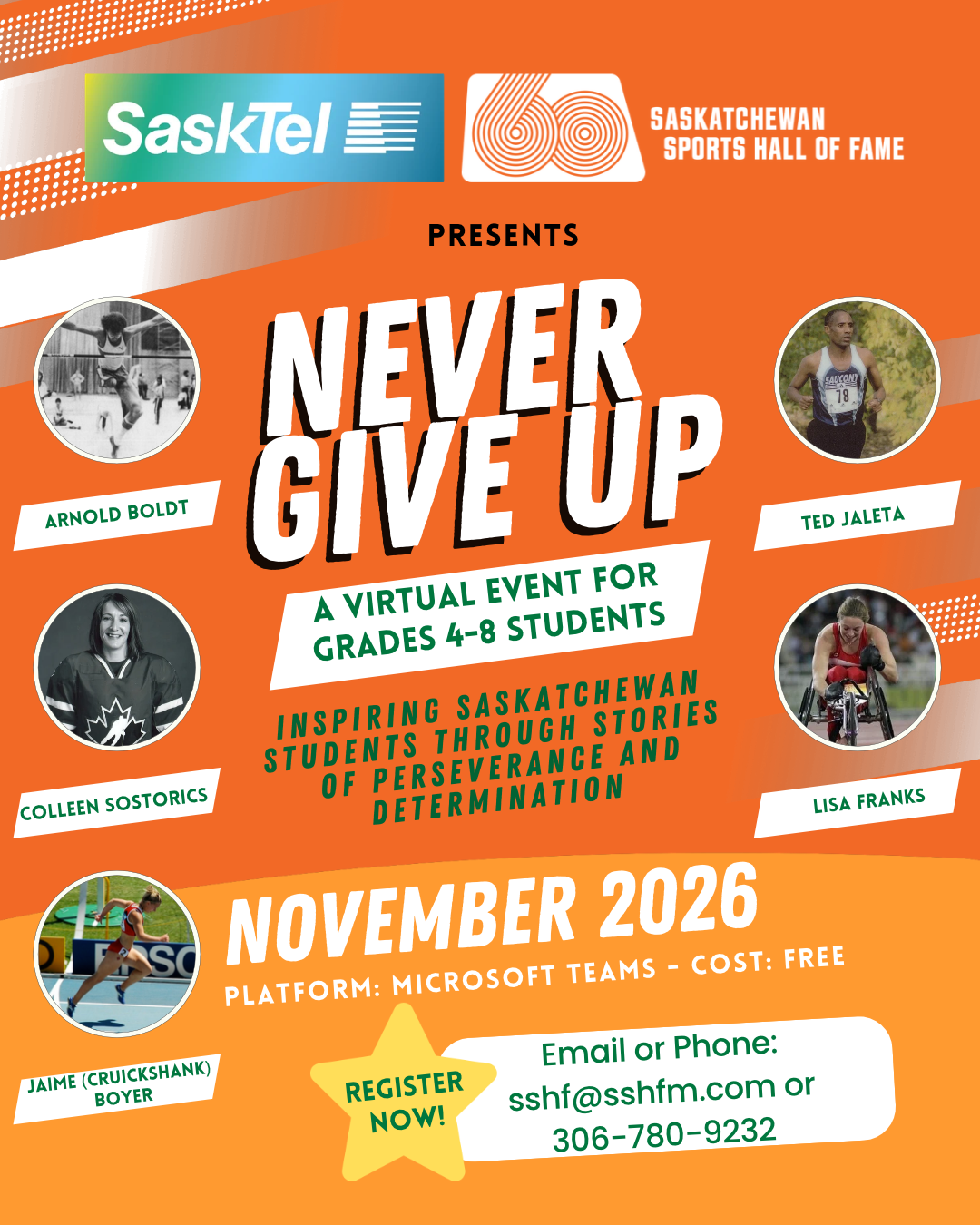
As the Saskatchewan Sports Hall of Fame celebrates 15 years of its Never Give Up program, we reflect on the remarkable journey of Ted Jaleta, whose personal experiences helped inspire a program that continues to connect with young people across Saskatchewan.
“Someday you find someone believes in you.”
Those words came from Saskatchewan Sports Hall of Fame inductee Ted Jaleta during a recent conversation about the 15th anniversary of the Never Give Up program. We were talking about the importance of encouragement, particularly for young people who may be struggling to find their place in the world.
For Ted, those words come from personal experience. His journey from Ethiopia to Saskatchewan was far from easy, and the challenges he faced along the way have shaped much of what he shares with students today.
Since 2011, the Saskatchewan Sports Hall of Fame’s Never Give Up program has brought athletes and role models into classrooms to share their experiences with perseverance, adversity, and determination. Ted’s own life story helped inspire the program, and 15 years later, he continues to believe in its importance.
For Ted, sharing those lessons has become a way of giving back to others. Having experienced displacement, uncertainty, and the struggle to find belonging himself, he understands the difference that encouragement and compassion can make in someone’s life. But sharing those lessons also means revisiting experiences that remain deeply emotional.
A Dream Interrupted
Born in Ethiopia, Tewodros “Ted” Jaleta was a talented young distance runner with dreams of competing in the Olympic Games. He became Ethiopia’s national high school 10,000-metre champion and was selected for the national junior team in 1973.
But civil war and political upheaval changed the direction of his life. Rather than continuing to pursue his Olympic ambitions, Ted was forced to flee his homeland.
He eventually arrived in Canada in 1982, where he faced the challenges of starting over in a country that was unfamiliar to him.
During our conversation, Ted spoke about those early years in Canada. He remembered feeling alone, uncertain about his future, and struggling to find acceptance. His accent and unfamiliarity with Canadian culture sometimes made him feel different, and he recalled being judged or passed over for opportunities. Sport became an important part of finding his place.
Ted returned to competitive running and went on to become one of Saskatchewan’s accomplished distance runners. He recorded more than 40 road-racing victories, won three Canadian Masters Road Race Championships, and earned international recognition for his achievements. In 2005, he was inducted into the Saskatchewan Sports Hall of Fame.
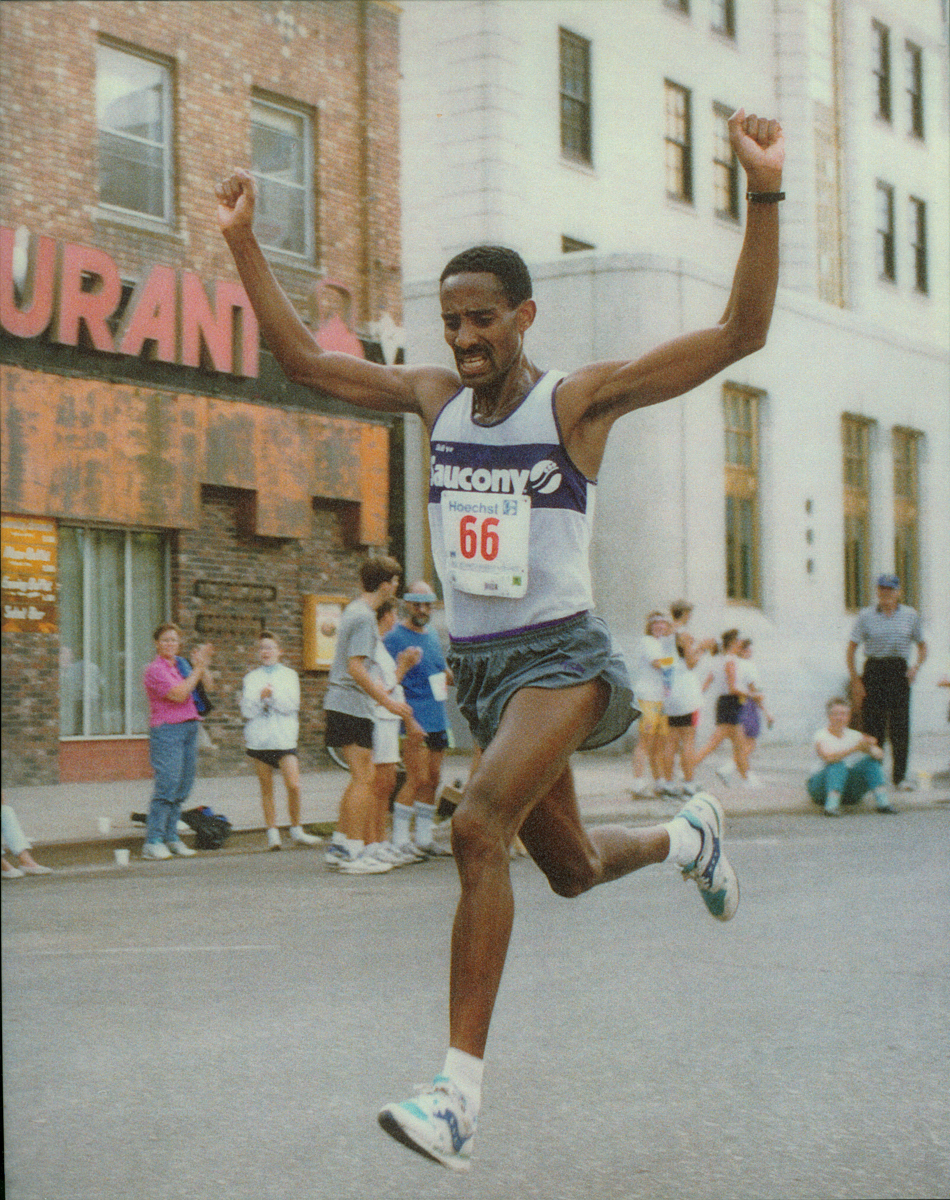
Photo: Ted Jaleta at the 1991 Regina 10K Provincial Championship.
His accomplishments are impressive, but what became clear during our conversation is that Ted doesn’t particularly like talking about medals or victories. He would much rather talk about what it took to get there.
The Stories Worth Telling
Ted believes that the most meaningful stories athletes can share go beyond championships, records, and medals. While those achievements are worth celebrating, he has often found himself wishing athletes would speak more openly about the challenges, setbacks, and personal experiences that shaped their journeys.
What happened when things didn’t go as planned? How did they deal with disappointment? Were there times when they wanted to give up? And who helped them along the way?
These are the things Ted believes young people need to hear.
He explained that when students listen to someone who has achieved great things, they often see the success without understanding everything that came before it. Hearing about the struggles, mistakes, and difficult decisions can help students recognize that the people they admire have faced challenges too. It is an approach that has remained central to Never Give Up.
The program encourages students to think about what makes someone a hero, while introducing them to Saskatchewan athletes and community members whose contributions extend beyond their sporting accomplishments.
For Ted, the message has always been about helping young people recognize their own potential, regardless of where they come from or what challenges they may face.
The Difficult Part of Sharing
One of the things I wanted to ask Ted was how participating in Never Give Up had affected him personally. After 15 years of sharing his story with students, I wondered what it was like to return to those memories again and again. His answer was something I hadn’t fully considered.
He admitted that there are times when he doesn’t want to do it. Revisiting those experiences, he explained, can be emotionally difficult. There are memories he would rather not return to, and he sometimes finds himself trying to avoid certain parts of his story because he worries about becoming emotional in front of students.
“Emotionally hard,” was how he described it.
But he also acknowledged that sharing his experiences can be healing. I asked him whether he thought it was all right for students to see him become emotional.
“I guess we are human, right?” he replied.
That response resonated with me.
We often talk about athletes in terms of their strength, determination, and ability to overcome challenges. But we don’t always consider what it takes for someone to stand in front of a classroom and speak openly about experiences that still affect them. Ted has been doing that for 15 years.
He isn’t sharing a story that has become easy to tell simply because time has passed. Some parts are still difficult, and I think that is important to recognize. Perhaps that is also what makes his presentations so meaningful. Students aren’t just hearing about someone who overcame adversity. They are hearing from someone who is willing to acknowledge that those experiences remain part of his life.
The Difference One Person Can Make
When I asked Ted what keeps him coming back to Never Give Up, especially when sharing his story can be so difficult, he talked about the young people he has met over the years.
Through his involvement in sport, coaching, and community work, Ted has had opportunities to encourage young people at different stages of their lives. Some of those relationships have stayed with him for decades.
He recalled coaching a teenage boy during the 1990s who was going through a particularly difficult time at home. Ted recognized that the young man needed support and encouragement and became an important mentor in his life. The teenager continued his education, eventually earning a PhD and pursuing a career in cancer research.
Years later, Ted received an unexpected email from his former athlete. They eventually met for lunch in Regina, giving Ted an opportunity to reconnect with someone whose life he had been part of many years earlier.
Ted also remembered the young man’s mother thanking him for the role he had played during a difficult period in her son’s life. It was one of several stories Ted shared that demonstrated how much a coach, teacher, or mentor can influence someone’s future, sometimes without even realizing it.
Over the years, former students have approached Ted in public, sometimes long after attending one of his presentations, to tell him they still remember his words. One particularly interesting connection came through Jon Ryan, the former NFL punter and Super Bowl champion who was inducted into the Saskatchewan Sports Hall of Fame in 2025. Ryan remembered Ted speaking to his class when he was younger, a connection that stayed with him long after that visit.
For Ted, these encounters are reminders that we don’t always know what someone takes away from a conversation or how long those words might stay with them. He knows that not every presentation will change someone’s life. But if he can reach even one or two young people who are struggling, he believes the effort is worthwhile. And that is what keeps him coming back.
Fifteen Years of Never Giving Up
When Never Give Up began in 2011, it was built around the idea that personal stories could help students understand perseverance, resilience, and the importance of believing in themselves.
With the support of SaskTel, the program has grown into an important part of the Saskatchewan Sports Hall of Fame’s educational outreach.
Originally delivered through in-person classroom visits, Never Give Up transitioned to a virtual format during the COVID-19 pandemic, creating opportunities for students in communities across the province to participate.
Over the years, presenters including Arnold Boldt, Lisa Franks, Colette Bourgonje, Colleen Sostorics, and Jamie (Cruickshank) Boyer have shared their own experiences with students.
Each presenter brings something different to the program. Some have faced life-changing injuries or health challenges, while others have experienced setbacks in competition or difficulties in their personal lives. What connects their stories is a willingness to talk about those experiences and what they have learned from them.
Recently, I had the opportunity to sit in my first Never Give Up presentation with Arnold Boldt and a Grade 7 and 8 class from Indian Head, Saskatchewan. Arnold lost his leg in a farming accident when he was just three years old but went on to achieve international success in track and field before turning his attention to cycling. His story certainly resonated with the students. What was supposed to be a 45-minute session stretched to nearly an hour as students continued to ask thoughtful questions, eager to learn more about his experiences.
I mentioned this to Ted, who laughed and explained that 45 minutes is rarely enough. Students are curious. They want to ask questions, and often those questions go well beyond sport. For Ted, that curiosity is part of what makes the program so worthwhile. It gives young people an opportunity to speak directly with someone whose experiences may be very different from their own, but whose challenges and emotions they can still understand.
Finding Belonging
As we talked about the future of Never Give Up, Ted suggested something I hadn’t previously considered: expanding the program beyond schools to connect with newcomer communities. It was an idea that came directly from his own experiences.
Ted remembered arriving in Canada and feeling uncertain about where he belonged. He understands how difficult it can be to navigate a new culture, particularly when language, appearance, or personal circumstances make someone feel different.
He spoke about visiting classrooms where Indigenous students and newcomers recognized something of themselves in his experiences. Seeing someone who had faced similar challenges, he explained, could give them hope.
He suggested exploring opportunities with organizations such as the Regina Open Door Society, where Never Give Up could reach young people and families who might connect with these stories in different ways. I thought it was an excellent suggestion, particularly because sport can be such an important way for people to connect with their communities.
For Ted, sport helped him find opportunities and build relationships when he was trying to establish himself in Canada. He knows firsthand that its value extends well beyond competition. As the Saskatchewan Sports Hall of Fame looks toward the next chapter of Never Give Up, opportunities like these are worth exploring.
Ted hopes the program will continue to evolve, bringing new voices and experiences to students while keeping its original message at the centre.
A Legacy Beyond Running
Ted Jaleta has accomplished a great deal since arriving in Saskatchewan more than four decades ago. His achievements as a distance runner earned him a place in the Saskatchewan Sports Hall of Fame, and his contributions as a coach, mentor, and community member have continued long after his competitive running career.
Ted founded the Jaleta Pacers Running Club, where he continues to coach both adults and young people, encouraging physical fitness, personal development, and the positive values that come through sport. The club also organizes the annual Royal Road Race, held every Mother’s Day weekend. Since its establishment in 2011, the event has raised nearly $400,000 for local charities and community initiatives.
Much of that support has gone toward addressing food insecurity in schools and supporting educational programs. Through a partnership with the University of Regina, the club has also established scholarships for students who have overcome significant adversity while pursuing their education. It seems particularly fitting that these scholarships recognize the same determination and perseverance Ted has spent so many years encouraging through Never Give Up.
But after speaking with him, I think one of Ted’s most important contributions is something that can’t be measured in race victories or dollars raised for charity. It is the time he has spent encouraging young people, the relationships he has built, and his willingness to share experiences that are not always easy to talk about. What struck me most was his belief that setbacks are part of life, circumstances can change, and sometimes all it takes is one person believing in you to make a difference.
He has seen that happen through his own life and through the lives of people he has mentored. And even after 15 years, he continues to share those lessons, despite the emotional difficulty of revisiting his past.
As Never Give Up celebrates this anniversary, it is worth remembering that the program’s success is found in the students who remember a conversation years later, the young people who find encouragement when they need it, and the connections that continue long after a presentation has ended.
Ted understands that he may never know the full impact of sharing his story. But he knows that sometimes one person is enough. And after 15 years, that remains a pretty good reason to never give up.