Start Date: Friday, March 20, 2026End Date: Sunday, June 28, 2026
On the Body: Sport, Memory and the Clothes Athletes Wore is the Saskatchewan Sports Hall of Fame’s newest exhibit. It explores sport history through the textiles that inductees and athletes wore in competition.
Sport is not only played, it is worn. Across decades, uniforms act as second skins, absorbing effort, marking belonging, and carrying the physical traces of athletic life. While materials, styles, and technologies have evolved from the 1900s to the 2000s, the relationship between body and garment remains constant. On the Body: Sport, Memory and the Clothes Athletes Wore reveals how sport history is preserved not only in records and achievements, but in its fabric shaped by motion, impact, and memory.
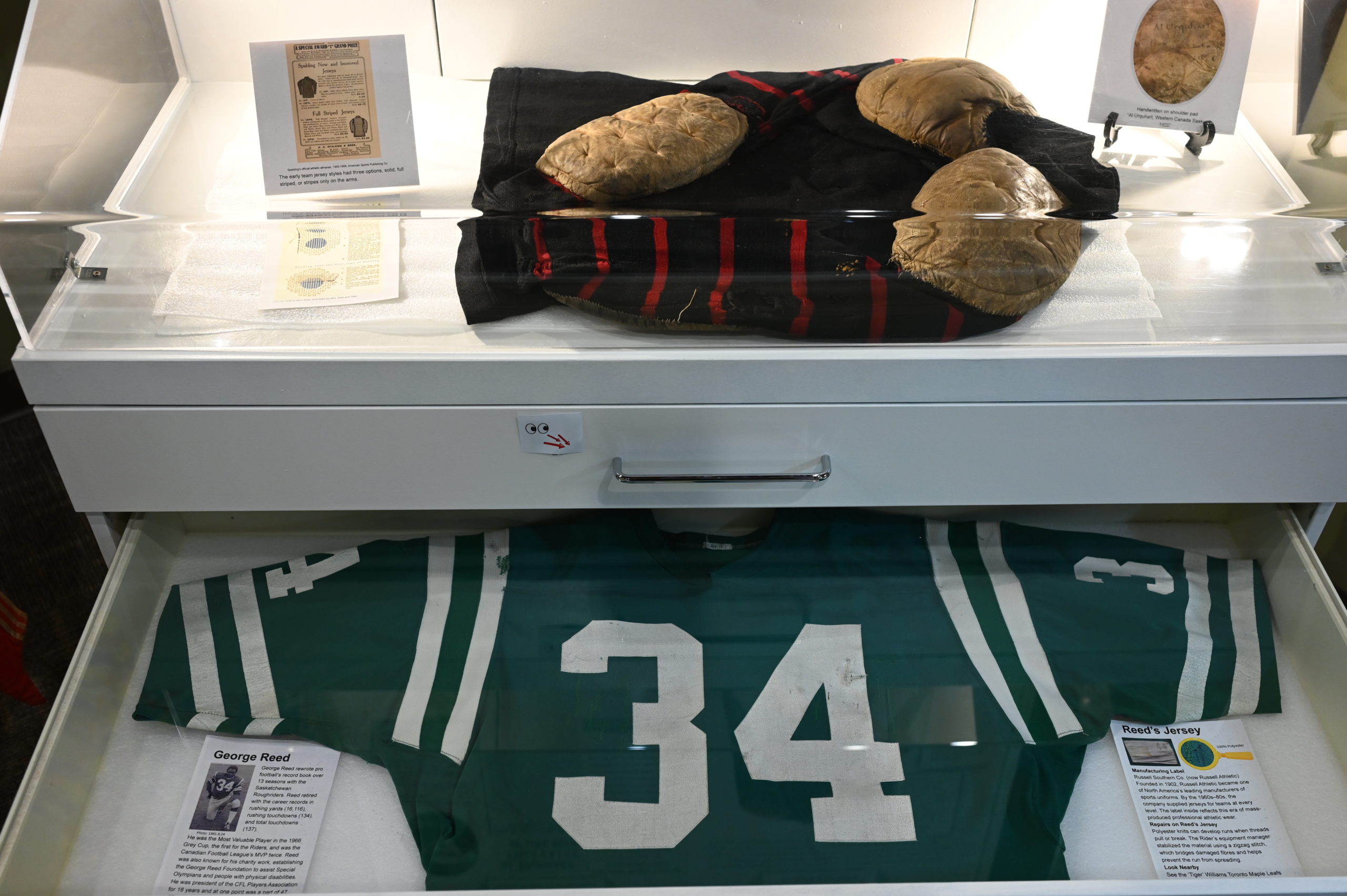
One of the highlights of the exhibit is Al Urquhart’s Regina Rugby Club uniform. Curator Robyn Jensen’s research has shown that Urquhart’s jersey was manufactured by Spalding in 1905. This ‘original Rider’ had the longest career of any of the 1910 players, spending 11 seasons with the Regina Rugby Club.
“The Sports Hall’s textile collection includes jerseys, pants/shorts, jackets, toques, hats, mitts, gloves, and shirts, each shaped by the needs of athletes in motion. For ‘On the Body: Sports, Memory and the Clothes Athletes Wore’, I’ve selected pieces with especially compelling stories. I’ve explored Al Urquhart’s jersey from the Regina Rugby Club and compared it with George Reed’s Saskatchewan Roughriders jersey,” Jensen said.
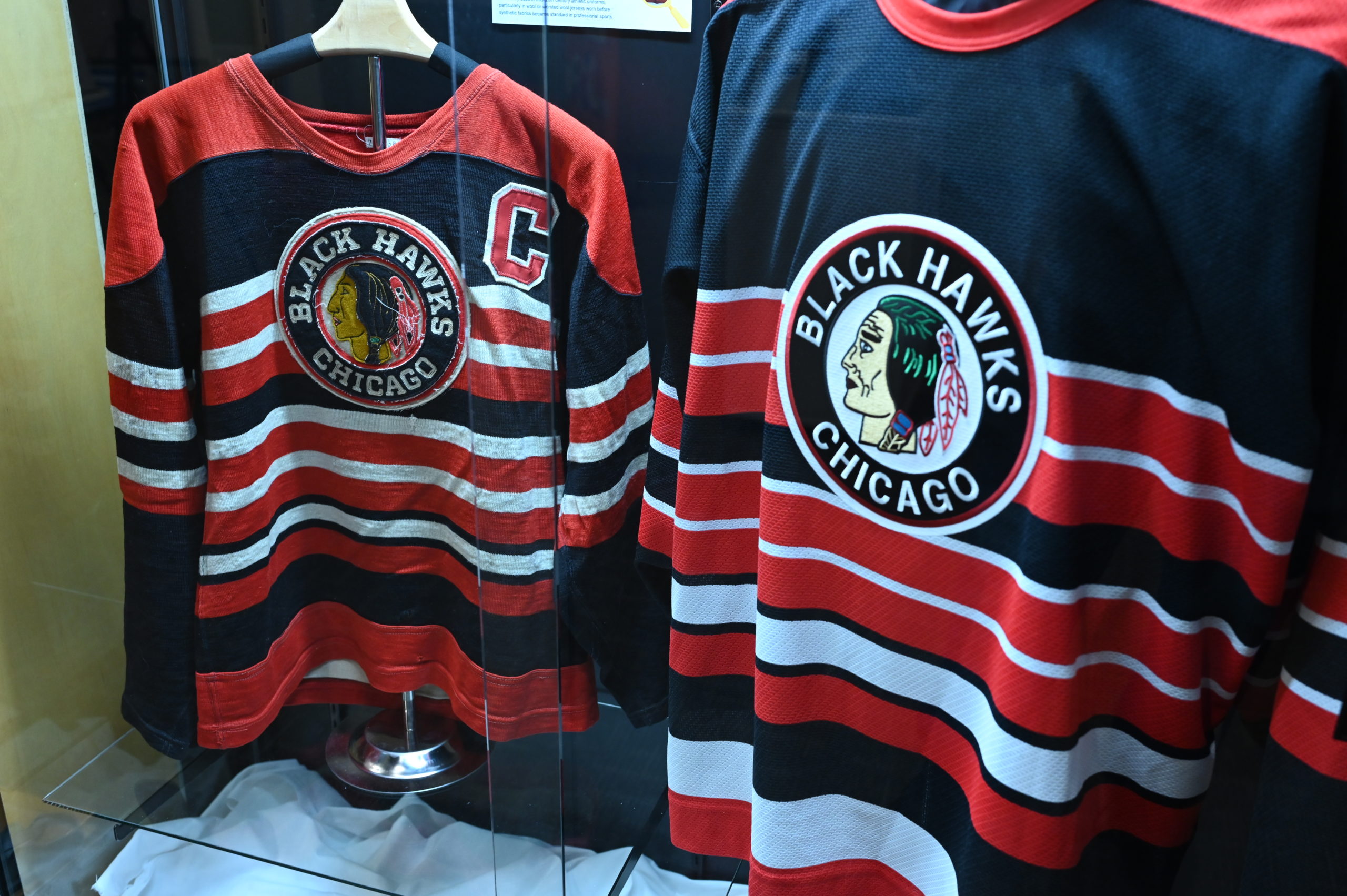
Doug Bentley’s Chicago Black Hawks jersey from his time as the team’s captain, left, beside an official reproduction of the same jersey using modern materials.
Other featured artifacts include Doug Bentley’s jersey from when he captained the Chicago Black Hawks. Game-worn jerseys from Reed and former Toronto Maple Leaf Dave ‘Tiger’ Williams will also be on display. Each of these artifacts shows the physical style of its wearer, with the mending visible on the jersey. Swimsuits and speed skating uniforms will also be featured, highlighting the technological advancements in fabrics and sport science.
Some of the uniforms on display are there to be touched, allowing visitors to feel how materials have evolved.
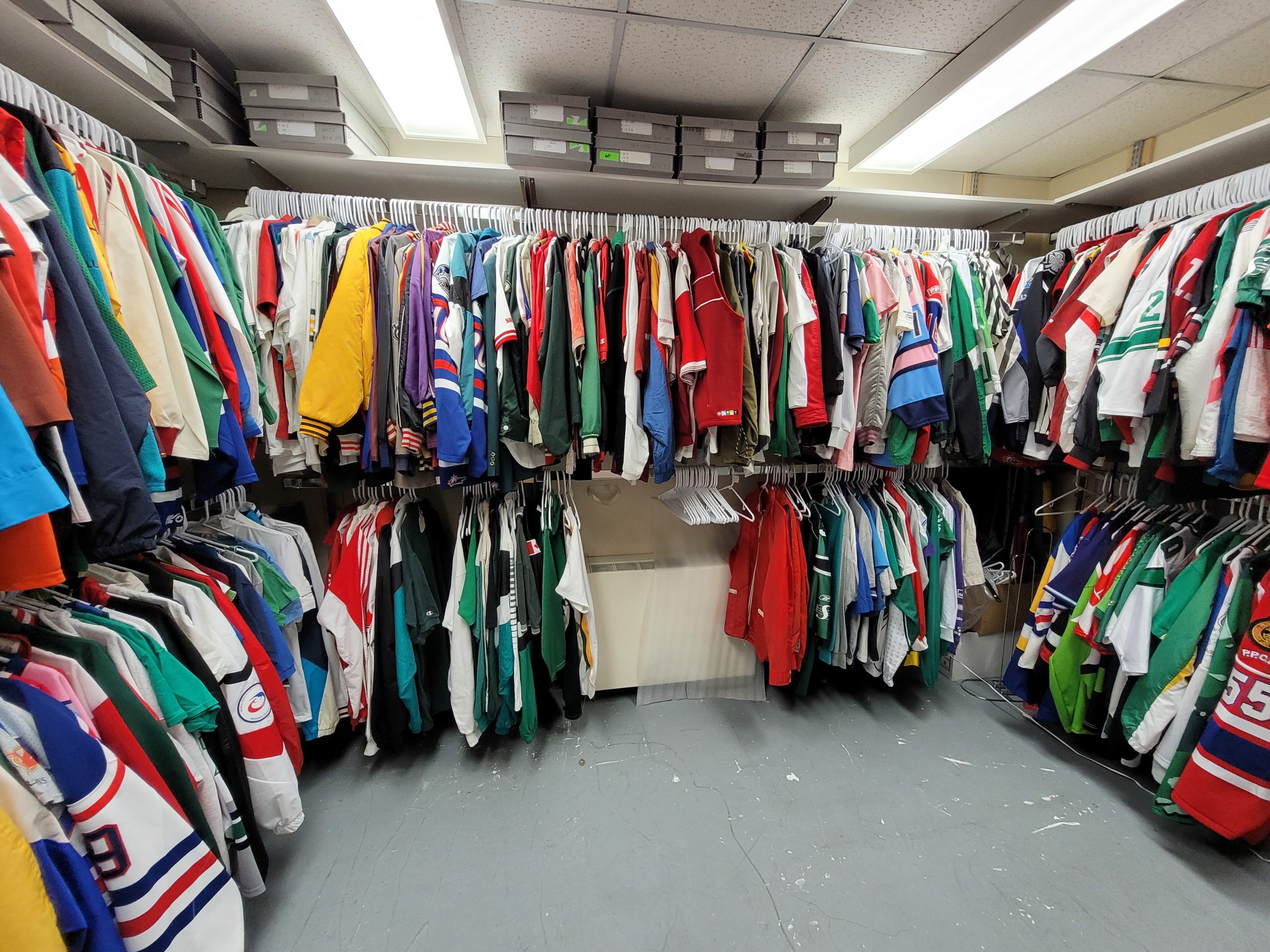
The Hall of Fame’s new textile room with archival boxes and hanging storage.
The exhibit also celebrates the completion of the SSHF’s textile project that saw our textile collection stored in a new space to provide easier access and better ease of care for these historic artifacts.
Through the Heritage Canada Grant, the SSHF was able to hire a curatorial assistant to complete the textile project. The construction work for the project was done by Blair Patterson of Son of Patter Enterprises.